
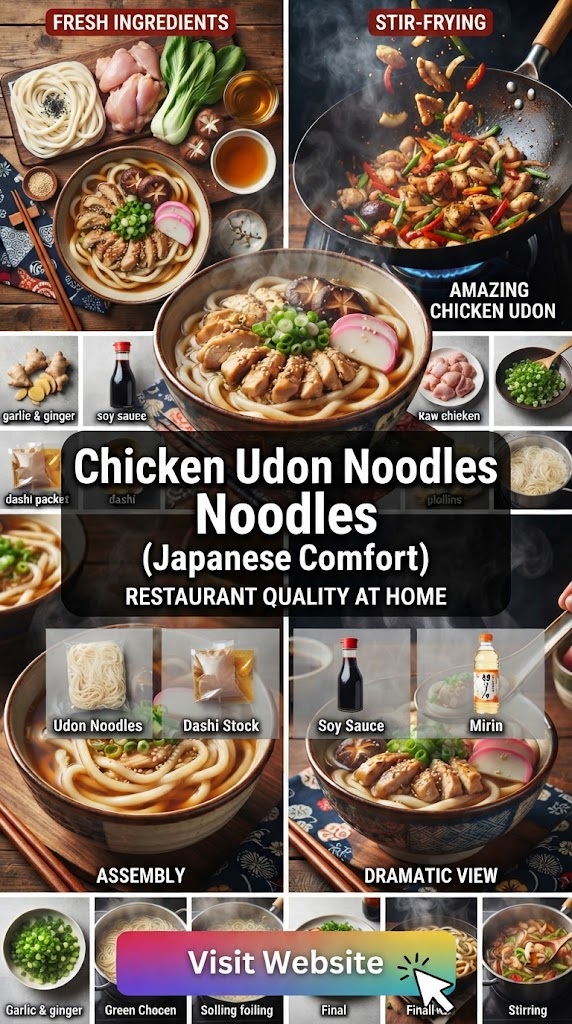
Chicken Udon Noodles (Japanese Comfort)
Chicken Udon Noodles are the perfect combination of chewy Japanese udon noodles, tender pieces of chicken, crisp vegetables, and a savory, slightly sweet sauce. This comforting dish comes together quickly in one pan and is satisfying enough for a complete lunch or dinner.
Unlike traditional noodle soups, this recipe focuses on stir-fried udon noodles coated in a flavorful Japanese-inspired sauce. The noodles become glossy and savory while the chicken stays juicy and the vegetables add color, crunch, and freshness.
Whether you are looking for an easy weeknight dinner, a comforting bowl of noodles on a chilly evening, or a homemade alternative to takeout, this Chicken Udon Noodles recipe is an excellent choice.
Why You’ll Love This Chicken Udon Recipe
There are plenty of reasons to keep this recipe in your regular dinner rotation.
Quick and Easy
The entire meal can be ready in about 30 minutes. Most of the cooking happens in one large skillet or wok, making preparation simple and cleanup easy.
Chewy, Delicious Udon
Udon noodles are thick, soft, and pleasantly chewy. They hold onto the sauce beautifully, giving every bite plenty of flavor.
Complete One-Pan Meal
Chicken provides protein, while vegetables add fiber, color, and texture. You can serve the noodles by themselves without needing several side dishes.
Better Than Takeout
Homemade udon lets you control the amount of salt, sweetness, spice, and oil. You can also add your favorite vegetables and adjust the chicken according to your preferences.
Family Friendly
The basic recipe has a savory, mildly sweet flavor without being overwhelmingly spicy. For people who enjoy heat, chili oil or red pepper flakes can easily be added at the table.
What Are Udon Noodles?
Udon is a thick Japanese wheat noodle known for its soft, springy, chewy texture. It is commonly served in soups, but it is also excellent for stir-frying.
For this recipe, vacuum-packed or refrigerated precooked udon noodles are especially convenient. They usually only need to be loosened in hot water before being added to the pan.
Frozen udon is another excellent option. Frozen noodles often have a wonderfully chewy texture and can be briefly boiled or thawed before stir-frying.
Dried udon can also work, but it should be cooked according to the package instructions and drained thoroughly before adding it to the stir-fry.
Chicken Udon Noodles Ingredients
For the Chicken
- 1 pound boneless, skinless chicken thighs or chicken breasts
- 1 tablespoon soy sauce
- 1 teaspoon sesame oil
- 1 teaspoon cornstarch
- 1 teaspoon freshly grated ginger
- 2 cloves garlic, finely minced
- ½ teaspoon black pepper
- 1 tablespoon neutral cooking oil
Chicken thighs are especially delicious because they remain juicy during high-heat cooking. Chicken breast works wonderfully too, particularly if you prefer leaner meat.
For the Noodles
- 14–16 ounces fresh, refrigerated, or frozen udon noodles
- 1 tablespoon neutral cooking oil
If using precooked udon, separate the noodles gently before stir-frying.
For the Vegetables
You can use almost any combination of stir-fry vegetables.
A delicious combination includes:
- 1 medium carrot, thinly sliced
- 1 cup sliced bell pepper
- 1 cup sliced mushrooms
- 1 cup shredded cabbage
- ½ medium yellow onion, thinly sliced
- 2 green onions, sliced
- 1 cup broccoli florets
You do not necessarily need every vegetable listed. Use what you have available.
Japanese-Style Udon Sauce
The sauce is what brings the entire dish together.
Sauce Ingredients
- ¼ cup low-sodium soy sauce
- 2 tablespoons oyster sauce
- 1 tablespoon mirin
- 1 tablespoon rice vinegar
- 1 tablespoon honey or brown sugar
- 1 teaspoon toasted sesame oil
- 1 teaspoon freshly grated ginger
- 1 garlic clove, minced
- 2 tablespoons water
- ½ teaspoon chili flakes, optional
Optional Thickening Mixture
For a slightly thicker, glossy sauce:
- 1 teaspoon cornstarch
- 1 tablespoon cold water
Mix these together until smooth before adding them to the pan.
Toppings
Toppings are optional, but they can make your Chicken Udon Noodles look and taste even better.
Try:
- Sliced green onions
- Toasted sesame seeds
- Nori strips
- Japanese chili seasoning
- Chili oil
- Crushed peanuts
- Fresh cilantro
- Thinly sliced red chili
- A small drizzle of sesame oil
For a simple finish, green onions and sesame seeds are all you need.
Kitchen Equipment
You do not need special equipment.
Recommended
- Large wok or skillet
- Cutting board
- Sharp knife
- Mixing bowl
- Small bowl for sauce
- Tongs or chopsticks
- Wooden spoon or spatula
- Colander
A wok is excellent because it distributes heat efficiently and gives you plenty of room to toss the noodles.
However, a large skillet works perfectly well.
How to Prepare Chicken Udon Noodles
Step 1: Prepare the Chicken
Start by cutting the chicken into thin, bite-sized pieces.
Try to cut the chicken into pieces of similar size. This helps everything cook evenly.
Place the chicken in a bowl.
Add:
- Soy sauce
- Sesame oil
- Cornstarch
- Ginger
- Garlic
- Black pepper
Toss thoroughly so every piece is coated.
Allow the chicken to marinate for approximately 10–15 minutes while you prepare the remaining ingredients.
You can skip the marinating time if you are in a hurry, but even a short marinade adds noticeable flavor.
Step 2: Mix the Sauce
Add the following ingredients to a small bowl:
- Soy sauce
- Oyster sauce
- Mirin
- Rice vinegar
- Honey or brown sugar
- Sesame oil
- Ginger
- Garlic
- Water
- Chili flakes, if using
Whisk until the honey or sugar is mostly dissolved.
Taste the sauce.
It should be savory, slightly sweet, lightly acidic, and deeply aromatic.
If you prefer a sweeter sauce, add another teaspoon of honey.
For more heat, add chili flakes or chili oil.
If the sauce tastes too salty, add another tablespoon of water.
Set it aside.
Step 3: Prepare the Udon Noodles
If using refrigerated precooked udon, place the noodles in a bowl of hot water for approximately 1–2 minutes.
This loosens the noodles and prevents them from breaking apart in the pan.
Drain thoroughly.
If using frozen udon, follow the package directions. Usually, the noodles can be briefly boiled until loosened.
Do not overcook the noodles.
They will continue cooking in the skillet.
The goal is to have noodles that are soft enough to separate but still chewy.
Step 4: Prepare the Vegetables
Slice all your vegetables before you begin cooking.
This is especially important when using a wok because stir-frying happens quickly.
Thinly slice:
- Onion
- Carrots
- Bell pepper
- Mushrooms
- Cabbage
Cut broccoli into small florets.
Keep harder vegetables separate from softer vegetables if possible.
For example, carrots and broccoli need more cooking time than cabbage and green onions.
Step 5: Cook the Chicken
Heat a large wok or skillet over medium-high to high heat.
Add 1 tablespoon of neutral cooking oil.
Once the oil is hot, carefully add the marinated chicken.
Spread the chicken into a single layer.
Let it cook undisturbed for about 2 minutes.
This allows the bottom to brown.
Then stir and continue cooking for another 3–5 minutes, depending on the size of the chicken pieces.
The chicken should be cooked through and lightly browned on the outside.
Remove the chicken from the pan and place it on a clean plate.
Do not worry if the chicken is not deeply browned at this stage. It will return to the pan later.
Step 6: Stir-Fry the Vegetables
Add another small drizzle of oil if the pan looks dry.
Add the onions and carrots first.
Stir-fry for approximately 2 minutes.
Add the bell pepper, broccoli, and mushrooms.
Continue cooking for another 2–3 minutes.
Finally, add the cabbage.
Cook for another minute.
The vegetables should be tender-crisp rather than completely soft.
You want them to retain some texture.
Overcooked vegetables can make the finished noodles watery and less enjoyable.
Step 7: Add the Udon
Add the prepared udon noodles to the skillet.
Using tongs or chopsticks, gently toss the noodles with the vegetables.
If the noodles are sticking together, add 1–2 tablespoons of water.
Toss gently until the noodles separate.
Avoid aggressively stirring them because udon noodles can break.
Step 8: Add the Sauce
Pour the prepared sauce around the noodles.
Toss everything together.
The sauce should quickly coat the noodles and vegetables.
Continue cooking for approximately 1–2 minutes.
The noodles should become glossy.
If you prepared the optional cornstarch slurry, stir it once more and add it now.
Cook for another 30–60 seconds.
The sauce will become slightly thicker and cling beautifully to the udon.
Step 9: Return the Chicken
Add the cooked chicken back into the skillet.
Toss everything together.
Cook for another 1–2 minutes.
This allows the chicken to absorb some of the sauce while reheating.
At this point, the dish should smell intensely savory and aromatic.
Turn off the heat.
Step 10: Finish With Toppings
Sprinkle the Chicken Udon Noodles with sliced green onions and sesame seeds.
For extra flavor, add a small drizzle of toasted sesame oil.
If you enjoy spicy noodles, add chili oil or Japanese chili seasoning.
Serve immediately while the noodles are hot and chewy.
How to Know When the Chicken Is Fully Cooked
Chicken should always be cooked thoroughly.
The safest method is to use an instant-read thermometer and check the thickest piece.
Chicken should reach an internal temperature of 165°F (74°C).
Avoid judging chicken only by its outside color.
Because the chicken pieces in this recipe are relatively small, they cook quickly, so keep an eye on them.
Best Chicken to Use
Chicken Thighs
Chicken thighs are my first choice for this recipe.
They are flavorful, juicy, and forgiving if cooked slightly longer.
Boneless, skinless thighs are easiest to work with.
Chicken Breast
Chicken breast creates a lighter version.
The key is to slice it thinly and avoid overcooking it.
Cornstarch in the marinade also helps create a tender surface.
Rotisserie Chicken
For an ultra-fast dinner, leftover cooked chicken can be used.
Simply shred or slice approximately 2–3 cups of cooked chicken and add it during the final stage.
Because the chicken is already cooked, it only needs enough time to heat through.
Best Vegetables for Chicken Udon
One of the best things about udon stir-fry is its flexibility.
Cabbage
Cabbage becomes slightly sweet as it cooks and works exceptionally well with soy-based sauces.
Carrots
Carrots add sweetness, color, and a pleasant crunch.
Mushrooms
Mushrooms contribute savory umami flavor.
Shiitake mushrooms are particularly good, but button or cremini mushrooms also work.
Bell Peppers
Bell peppers provide sweetness and bright color.
Broccoli
Broccoli adds substance and makes the meal more vegetable-heavy.
Snow Peas
Snow peas provide a crisp texture and cook quickly.
Bok Choy
Bok choy is another excellent Japanese-inspired addition.
Add the stems before the leaves because the stems require slightly more cooking time.
How to Prevent Soggy Udon
Soggy noodles are one of the most common problems with stir-fried udon.
Follow these simple rules.
Do Not Overcook the Noodles
The noodles only need to be loosened before going into the skillet.
Drain Well
Excess water can dilute the sauce and cause steaming instead of stir-frying.
Use High Heat
High heat helps evaporate moisture quickly.
Do Not Overcrowd the Pan
A crowded skillet traps steam.
If you are doubling the recipe, consider cooking it in batches.
Add Sauce Gradually
Start with the recommended amount.
You can always add more, but too much sauce can make the noodles soggy.
How to Make Extra-Saucy Chicken Udon
If you love lots of sauce, increase the sauce recipe by about 50%.
For example, use:
- 6 tablespoons soy sauce
- 3 tablespoons oyster sauce
- 1½ tablespoons mirin
- 1½ tablespoons rice vinegar
- 1½ tablespoons honey
- 1½ teaspoons sesame oil
Add the sauce gradually.
You may not need all of it.
How to Make Spicy Chicken Udon
For spicy udon noodles, add one or more of these ingredients:
- Chili oil
- Crushed red pepper
- Fresh sliced chili
- Japanese chili seasoning
- Sriracha
- Chili garlic sauce
For balanced heat, add the spice to the sauce rather than simply sprinkling it over the finished noodles.
A teaspoon of chili oil provides a pleasant medium level of heat without overpowering the savory sauce.
How to Make Garlic Chicken Udon
If you are a garlic lover, increase the garlic to 4–5 cloves.
Add half of the garlic to the chicken marinade.
Add the remaining garlic during the vegetable stir-frying stage.
This creates two layers of garlic flavor: one mellow and one aromatic.
How to Make Teriyaki-Style Chicken Udon
For a sweeter teriyaki-inspired version, increase the honey or brown sugar to 2 tablespoons.
You can also add:
- 1 tablespoon extra mirin
- 1 teaspoon grated ginger
The result will be sweeter, glossy, and excellent with steamed broccoli.
How to Make Vegetarian Udon
This recipe is easy to turn into a vegetarian meal.
Simply replace the chicken with:
- Tofu
- Mushrooms
- Edamame
- Tempeh
- Extra vegetables
Use vegetarian oyster sauce or mushroom stir-fry sauce in place of regular oyster sauce.
Crispy tofu is particularly delicious with udon.
How to Make Chicken Udon Soup
If you prefer a warm noodle soup instead of stir-fried udon, you can adapt the recipe.
Prepare a broth using:
- 4 cups chicken broth
- 2 tablespoons soy sauce
- 1 tablespoon mirin
- 1 teaspoon sesame oil
- 1 teaspoon grated ginger
- 1 garlic clove
Bring the broth to a gentle simmer.
Add cooked chicken and vegetables.
Add udon noodles near the end.
Simmer just until everything is hot.
Finish with green onions and sesame seeds.
This version is especially comforting during cold weather.
Serving Suggestions
Chicken Udon Noodles can easily be served as a complete meal.
For a larger Japanese-inspired dinner, consider adding:
- Miso soup
- Cucumber salad
- Edamame
- Steamed broccoli
- Japanese-style pickles
- Seaweed salad
- Gyoza
- Spring rolls
Because the noodles are already substantial, you generally do not need many side dishes.
Storage Instructions
Allow leftovers to cool slightly before transferring them to an airtight container.
Store in the refrigerator for up to 3–4 days.
Keep the noodles refrigerated promptly rather than leaving them at room temperature for an extended period.
How to Reheat Chicken Udon
The best method is reheating in a skillet.
Add the noodles to a skillet over medium heat.
Add 1–2 tablespoons of water.
Cover for about 1 minute to create gentle steam.
Remove the lid and toss until hot.
If the noodles seem dry, add a small splash of soy sauce or water.
Microwaving is also possible.
Place the noodles in a microwave-safe container and add a tablespoon of water.
Cover loosely and heat in short intervals, stirring between intervals, until thoroughly hot.
Can You Freeze Chicken Udon?
You can freeze the cooked chicken and vegetables, but cooked udon noodles may become softer after freezing and thawing.
For the best texture, prepare the chicken and sauce ahead of time and cook fresh udon when you are ready to serve.
If freezing the completed dish, cool it promptly, place it in an airtight freezer-safe container, and use it within a reasonable period for best quality.
Thaw in the refrigerator before reheating.
Make-Ahead Instructions
Chicken Udon Noodles are excellent for meal preparation.
You can prepare several components ahead of time.
The Chicken
Slice and marinate the raw chicken up to several hours ahead, keeping it refrigerated.
The Sauce
Mix the sauce in advance and refrigerate it in a sealed container.
The Vegetables
Wash and cut the vegetables ahead of time.
Store them refrigerated in airtight containers.
The Noodles
Keep refrigerated or frozen according to the package instructions.
When dinner time arrives, the cooking process becomes extremely fast.
Common Mistakes to Avoid
1. Using a Cold Pan
A cold pan causes the chicken to release moisture rather than brown.
Always preheat the skillet.
2. Overcrowding
Too many ingredients at once reduce the pan temperature.
Cook in batches when necessary.
3. Overcooking Udon
Udon should remain chewy.
Do not boil precooked noodles for a long time before stir-frying.
4. Adding Too Much Sauce
Too much liquid can make the noodles soggy.
Start with less and add more if needed.
5. Cutting Chicken Too Thick
Large chicken chunks take longer to cook and can become dry outside before the center is ready.
Thin, even slices are ideal.
6. Overcooking Vegetables
Vegetables should retain some bite.
Stir-frying is quick, so keep the heat relatively high.
Tips for Restaurant-Style Chicken Udon
Use High Heat
Restaurant stir-fries often have intense heat. A hot wok gives the ingredients a lightly charred flavor.
Prepare Everything First
Once the pan is hot, there is little time for chopping.
Have your chicken, vegetables, sauce, and noodles ready before cooking.
Don’t Stir Constantly
Allow chicken and vegetables to sit against the hot surface for short periods so they can brown.
Use Toasted Sesame Oil Carefully
Toasted sesame oil is powerful.
A small amount at the end adds excellent aroma.
Finish With Fresh Green Onion
Fresh green onion provides a bright contrast to the rich sauce.
Ingredient Substitutions
You can easily customize this recipe.
| Ingredient | Substitute |
|---|---|
| Chicken thighs | Chicken breast |
| Chicken | Tofu or shrimp |
| Soy sauce | Tamari |
| Oyster sauce | Vegetarian oyster sauce |
| Mirin | A little extra rice vinegar + sugar |
| Honey | Brown sugar |
| Fresh ginger | ½ teaspoon ground ginger |
| Udon | Thick wheat noodles |
| Rice vinegar | Mild white vinegar |
| Sesame oil | Neutral oil for cooking |
If using tamari, remember that flavor and saltiness can vary between brands, so adjust the sauce to taste.
Frequently Asked Questions
Can I use frozen udon noodles?
Yes. Frozen udon is an excellent choice and often has a particularly chewy texture.
Prepare it according to the package directions, then drain thoroughly before adding it to the stir-fry.
Can I use chicken breast?
Absolutely.
Slice the chicken thinly and avoid overcooking it.
Can I make this without oyster sauce?
Yes.
Use vegetarian oyster sauce, mushroom stir-fry sauce, or increase the soy sauce slightly.
Keep in mind that oyster sauce contributes sweetness and umami, so the flavor will be slightly different.
Is Chicken Udon spicy?
The basic recipe is not particularly spicy.
The chili flakes are optional.
Can I add an egg?
Yes.
A fried egg on top is delicious.
You can also scramble an egg into the vegetables before adding the noodles.
Can I use leftover chicken?
Definitely.
This is one of the easiest ways to turn leftover chicken into a new meal.
What mushrooms work best?
Shiitake mushrooms are excellent, but button, cremini, oyster, and enoki mushrooms can also be used.
Nutrition Information
Approximate nutrition will vary depending on the exact ingredients and portion sizes.
For one serving, this recipe generally provides a substantial amount of:
- Protein from chicken
- Carbohydrates from udon
- Fiber and micronutrients from vegetables
- Fats from cooking oil and sesame oil
For a lighter version, use chicken breast, reduce the oil, increase the vegetables, and choose low-sodium soy sauce.
For a higher-protein version, increase the chicken or add edamame.
Easy Variations
Honey Garlic Chicken Udon
Increase the honey and garlic for a sweeter, richer noodle dish.
Teriyaki Chicken Udon
Use teriyaki sauce in place of part of the soy-based sauce.
Spicy Korean-Inspired Udon
Add gochujang and chili flakes for a deeper, spicy flavor.
Sesame Chicken Udon
Add extra toasted sesame seeds and a small spoonful of tahini or sesame paste to the sauce.
Vegetable Udon
Skip the chicken and double the mushrooms, cabbage, carrots, broccoli, and peppers.
Shrimp Udon
Replace chicken with peeled shrimp.
Cook shrimp quickly because they can become rubbery when overcooked.
A Simple Dinner Timeline
If you want to make this recipe efficiently, organize your cooking in this order:
Minute 0–5:
Slice chicken and vegetables.
Minute 5–8:
Mix the sauce and prepare the udon.
Minute 8–13:
Cook the chicken.
Minute 13–18:
Stir-fry the vegetables.
Minute 18–22:
Add udon and sauce.
Minute 22–25:
Return chicken, toss everything together, and finish with toppings.
That makes this a realistic weeknight dinner in roughly 25–30 minutes.
Complete Chicken Udon Noodles Recipe Card
Chicken Udon Noodles
Prep Time: 15 minutes
Cook Time: 15 minutes
Total Time: About 30 minutes
Servings: 4
Cuisine: Japanese-inspired
Course: Main Course
Method: Stir-fry
Ingredients
Chicken
- 1 pound boneless, skinless chicken thighs or breasts
- 1 tablespoon soy sauce
- 1 teaspoon sesame oil
- 1 teaspoon cornstarch
- 1 teaspoon grated ginger
- 2 garlic cloves, minced
- ½ teaspoon black pepper
- 1 tablespoon neutral oil
Noodles
- 14–16 ounces udon noodles
- 1 tablespoon neutral oil
Vegetables
- 1 carrot
- 1 bell pepper
- 1 cup mushrooms
- 1 cup shredded cabbage
- ½ onion
- 1 cup broccoli
- 2 green onions
Sauce
- ¼ cup low-sodium soy sauce
- 2 tablespoons oyster sauce
- 1 tablespoon mirin
- 1 tablespoon rice vinegar
- 1 tablespoon honey or brown sugar
- 1 teaspoon sesame oil
- 1 teaspoon grated ginger
- 1 garlic clove, minced
- 2 tablespoons water
- ½ teaspoon chili flakes, optional
Instructions
- Slice the chicken into thin, bite-sized pieces.
- Add chicken to a bowl with soy sauce, sesame oil, cornstarch, ginger, garlic, and black pepper.
- Toss well and let it rest for 10–15 minutes.
- Mix all sauce ingredients in a small bowl.
- Prepare the udon according to the package instructions, just until loosened.
- Drain the noodles thoroughly.
- Heat a large wok or skillet over medium-high to high heat.
- Add cooking oil.
- Add chicken and cook until browned and fully cooked, approximately 5–7 minutes depending on thickness.
- Transfer chicken to a clean plate.
- Add another small amount of oil if necessary.
- Add onions and carrots and stir-fry for approximately 2 minutes.
- Add bell pepper, broccoli, and mushrooms.
- Cook for another 2–3 minutes.
- Add cabbage and cook for approximately 1 minute.
- Add udon noodles.
- Toss gently to combine.
- Pour in the prepared sauce.
- Toss continuously for 1–2 minutes until the noodles are glossy and coated.
- Return cooked chicken to the pan.
- Toss everything together for another 1–2 minutes.
- Turn off the heat.
- Garnish with green onions and sesame seeds.
- Serve immediately.
Final Tips for Perfect Chicken Udon
For the best possible Chicken Udon Noodles, remember these key points:
Use a hot pan. High heat gives you better browning and prevents the ingredients from becoming watery.
Keep the noodles chewy. Precooked udon only needs to be loosened before stir-frying.
Cut everything evenly. Similar-sized chicken and vegetable pieces cook more consistently.
Don’t drown the noodles in sauce. Udon should be glossy and flavorful rather than swimming in liquid.
Cook the chicken separately first. This allows it to brown properly and prevents the vegetables from becoming overcooked while waiting for the chicken.
Add fresh toppings at the end. Green onions, sesame seeds, chili oil, or nori can transform the finished dish.
Taste before serving. Soy sauces and oyster sauces vary in saltiness. Adjust with a little water, soy sauce, vinegar, or sweetness depending on the flavor you want.
Conclusion
Chicken Udon Noodles are one of those meals that prove homemade comfort food does not need to be complicated. Thick, chewy udon noodles are tossed with tender chicken, colorful vegetables, and a rich Japanese-inspired sauce to create a satisfying dinner in around 30 minutes.
The recipe is flexible enough for busy weeknights and special enough to serve when you are craving something that feels like restaurant-style comfort food. You can make it spicy, sweet, garlicky, extra vegetable-packed, or completely customize the protein.
Once you have the basic method down, the possibilities are nearly endless: swap chicken for shrimp, tofu, or beef; change the vegetables according to the season; increase the chili for heat; or add a fried egg for an extra-rich finish.